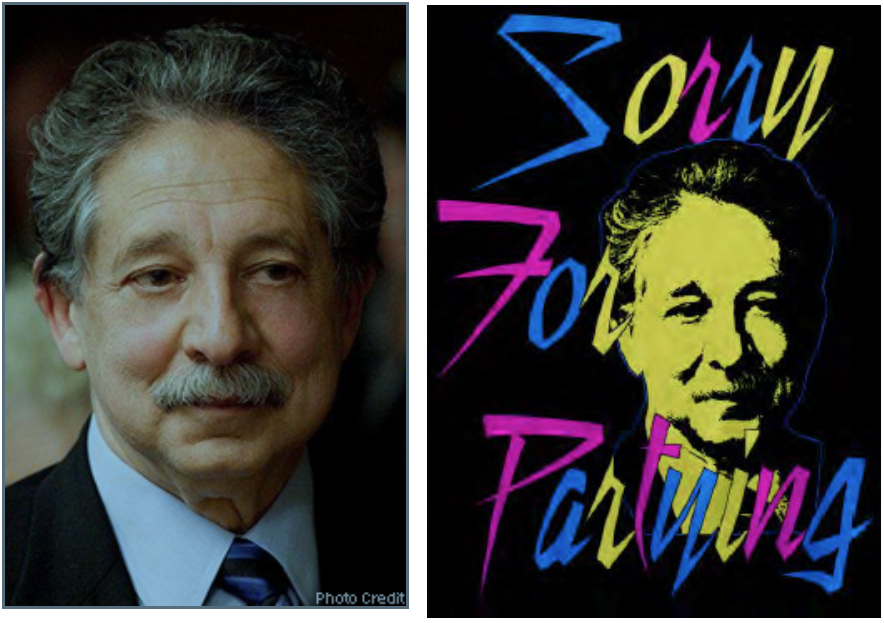
Anthony Falzone writes about the court's decision to stop publication of The Harry Potter Lexicon, ruling against Fair Use. All is not over. He writes:

Finally, remember that avada kedavra -- the killing curse -- is not always fatal. One wizard survived it. Three times. And it was he who cast the spell (and won't be named here) that ultimately suffered for it. Maybe someday the Lexicon will be known as The Book That Lived.

Here is Stanford's offical press release:

STANFORD, Calif., September 8, 2008— Stanford Law School’s Fair Use Project has released the following statement on behalf of RDR Books and its counsel regarding today’s decision on Warner Bros. Entertainment Inc. et al v. RDR Books et al issued by U.S. District Judge Robert B. Patterson:

“We are encouraged by the fact that the Court recognized that as a general matter authors do not have the right to stop the publication of reference guides and companion books about literary works. As for the Lexicon, we are obviously disappointed with the result, and RDR Books is considering all of its options, including an appeal.”

Court decision and filings here at Justia: Warner Bros. Entertainment Inc. et al v. RDR Books et al 

Minow: Tell us about the new Digital Copyright Slider. How does it work and what is its purpose?


Brewer: The “Is it Covered by Copyright?” Slider was created as the first in a series of simple tools to help librarians, educators and others with their copyright questions.  We first created a print version as a slide chart, but realized that a digital version could be much more useful, though perhaps not as fun to play with. Thus, the digital version was born.  Both versions of the slider help the user to determine whether or not a work is in the public domain in the United States, and, if not, what the period of protection is. 


Our next tool, a Section 108 “spinner” (library/archival reproductions for preservation, replacement or for users) will be released shortly both in print and online, so stay tuned.


Minow: What is the American Library Association Office for Information Technology Policy Copyright Committee?


Brewer: The American Library Association Office for Information Technology Policy Copyright Advisory Subcommittee promotes copyright education programs and initiatives and advises the OITP copyright specialist. We meet twice a year at ALA annual and mid-winter. Our meetings are open to any interested ALA members.  Many members are actively involved in the Copyright Advisory Network at http://www.librarycopyright.net/


MichaelBrewer.jpg
Michael Brewer is Team Leader for Undergraduate Services, University of Arizona Library and a member of the American Library Association Office for Information Technology Policy Copyright Advisory Subcommittee

The outcome of the hearing we previously blogged about is that the Oregon Legislative Counsel Committee will not assert copyright on the Oregon Revised Statutes.

Public.resource.org has put up video of the hearing in 6 segments.  Find out more on public.resource.org/oregon.gov/.

Audio recording of Legislative Counsel committee hearing in Oregon on copyright status of Oregon Revised Statutes - June 19, 2008.  Listen for Tim Stanley's vision of building on the Statutes with technology and community. E.g. include earlier versions, tagging,  allowing law professors and others to add comments, and more. Here's the Justia site.

http://www.leg.state.or.us/listn/archive/archive.2007i/JLC-200806191025.ram 

(thanks, Tim, Cicely and Nick) 

Justia has made the Yoko Ono Lennon v Premise Media court documents available.  Congratulations to the  Stanford Fair Use Project for its Fair Use defense.


Copyright Renewal Dataset Available

| | Comments (0)

The Stanford University Libraries are pleased to announce that the full dataset for its Copyright Renewal Database is now available for download.

A link to the file is found on the CRD database website or download the dataset directly: http://collections.stanford .edu/copyrightrenewals/files /CopyrightRenewalRecords200804 26.zip

Provision of the dataset is an additional service that we hope will be useful to those of you who are interested in setting up internal copyright search systems of your own. The web interface will remain the same for those of you who want to use it for occasional research.

The libraries continue to be asked about plans to expand our data set to include other classes of works. While we have not ruled it out, we do not have plans for such an effort at the moment. This is primarily a funding issue, but it is important to remember that for the book database we were able to leverage the extraordinary work of Project Gutenberg in transcribing the Catalog of Copyright Entry text. Since those transcriptions don't exist for classes other than books, there is an additional layer of effort required to add additional data classes.

Mimi Calter
Special Projects Librarian and Intellectual Property Manager
Stanford University Libraries

The Stanford Copyright & Fair Use site continues to updates its current featured cases, dockets, legislation, etc. For updates on the Harry Potter case, the PRO-IP bill and more, see CURRENT tab.

Comments are now open

| | Comments (0)

Nick added a comments feature to this blog. Feel free to take advantage of your opportunity to talk to us. Thanks, Nick.


We return to our interview with Jonathan Pink, partner at Lewis Brisbois Bisgaard & Smith. Jonathan Pink represented the defendants in Marketing Information Masters, Inc. v. The Board of Trustees of the California State University System, et. al. (06cv 1682 JAH, SDCA February 5, 2008).


Minow: Your case about the copyright immunity of a state university has attracted a lot of attention (see Slashdot).


Here are a couple of follow up questions. When is a state employee acting in an "official" capacity (and thus enjoying state immunity) versus an "individual" capacity (and thus facing copyright liability)?


Pink: The Supreme Court has said that a state official who violates federal law "is in that case stripped of his official or representative character and is subjected in his person to the consequences of his individual conduct."  Ex parte Young, 209 U.S. 123, 160 (1908).  Translated, this means that where the actions undertaken by the state official violated the plaintiff's federally protected rights, the official may be held personally liable in his or her individual capacity. 


In Marketing Information Masters, I intend to establish that the professor never violated the plaintiff's federally protected rights, and thus cannot be held individually liable for the claims asserted.  The Court has not yet ruled on this issue.  It has only ruled that the University and the professor acting in his "official" capacity are entitled to immunity under the 11th Amendment. 


The fact that the Court left open the question of whether the professor can be held liable in his "individual" capacity, however, highlights what I believe is a logical flaw in applying Ex Parte Young to a case such as this one. It makes no sense to say that a professor acting within the course and scope of his or her employment may be stripped of 11th Amendment protection anytime the underlying claim is established, and that protection exists only where the underlying claim fails.  That would effectively render meaningless the protection afforded a professor in his or her "official" capacity, and would run contrary to established agency law.  I can't imagine any policy underpinning that would support such a ruling.


Moreover, most of the cases that followed Ex Parte Young are factually distinct from the Marketing case.  Most of those cases involved Civil Rights actions where there is sound public policy in favor of  protecting the public from, say, rogue police officers.  The one case to discuss the Ex Parte Young rule in a copyright context (Richard Anderson Photography v. Brown, 852 F.2d 114 (4th Cir.1988)) provided little-to-no analysis on this issue, and is of little help in navigating these waters. Because of this, I'll argue that Ex Parte Young and its progeny should not apply here.  I suspect this will be the next big fight in this case. 


Minow: Assuming agency law prevails, is it not best for the university to have a generous policy, if they want to shield their employees?


On the other hand, it seemed the court was influenced by the overall university's lack of record of infringement... so if a university had an irresponsible (where's the line between generous and irresponsible?) copyright policy that allowed too much, could that tip the other way?


Pink: Many states, including California, have statutes requiring the state to pay damage awards levied against state officials for acts performed in the course of their official duties. (Calif. Gov. Code Section 825.)


It does appear that the Court considered the absence of any pronounced history of State-sanctioned infringement when ruling that the Copyright Remedy Clarification Act of 1990 was unconstitutional.  While the plaintiff asked the Court to imagine a world where State-operated academic institutions transgressed copyright laws with complete impunity, I think the Court recognized that this was not the reality.  The Court also recognized that Congress apparently had little evidence of such abuse when it decided to enact the CRCA.  


Minow: Do local government and its employees enjoy copyright immunity?


Pink:  By enacting the CRCA, Congress intended to subject States to suit for copyright infringement.  If the CRCA is invalidated, the Eleventh Amendment would again bar a suit for copyright infringement against the States and their officials when acting in their official capacity.  If a local government can be categorized as an instrument of the State, I would suspect that a good argument could be made that it too enjoys the same immunity.  


Minow: Do you know if the case will be appealed?


Pink: The plaintiff has promised to appeal the Court's invalidation of the CRCA.  From my perspective, this would be a waste of time, money and judicial resources.  While the Supreme Court has never directly ruled on this issue, the Court has already invalidated Congress' efforts to subject the States to patent and trademark infringement claims based on statutes nearly identical to the CRCA. These are Florida Prepaid v. College Savings Bank, 527 U.S. 627 (1999)and College Savings Bank v. Florida Prepaid Postsecondary Education Expense Fund, 527 U.S. 666 (1999). The Court has also intimated that the CRCA does not pass constitutional muster when remanding Chavez v. Arte Publico Press, 517 U.S. 1184 (1996) for a ruling consistent with the holdings in Florida Prepaid and College Savings Bank.   

Minow:  What recommendations by the Section 108 Study Group would really help libraries, museums and archives if adopted into law?


Hirtle: Most of the recommendations from the group could help libraries, archives, and museums, but four stand out to me. 


First, the report argues that at least some museums should be included in the section.  That is not currently the case. 


Second, the report proposes that there be a broad preservation exemption for published materials.  It is possible that having explicit permission to preserve in Section 108 might reassure some libraries that are reluctant to preserve under the more ambiguous provisions of fair use. 


Third, the provisions that grant libraries, archives, and museums explicit permission to do some of the things that the Internet Archive does under the umbrella of fair use may also be helpful. 


Lastly, the recommendations address many of the absurdities in the current law.  Here are two examples:


*     Under current law, if a library made a replacement copy of an audio CD, it would no longer be able to loan that CD to its patrons (because digital replacement copies are restricted to the premises of the library - and audio CDs are digital). 


*     Certain preservation and replacement provisions limit the library to making three copies.  This makes sense when you are talking about microfilm, but doesn't make much sense when you are dealing with digital copies.


Minow: Anything that could hurt libraries, museums and archives?


Hirtle: There is always the danger that providing explicit permission for certain actions could imply that other actions outside the scope allowed in the section are suspect.  Section 108 should never be a ceiling on what is acceptable except in those cases where it goes beyond what other sections, such as fair use, would allow.


The biggest threat will occur when 108 is opened for legislative amendment.  The Study Group received proposals from many interest groups that would be very problematic for libraries, archives, and museums.  I am thinking in particular of the suggestions that international ILL be banned and that libraries would need to determine if an article was available for sale from the publisher prior to making an ILL request.  Most libraries would welcome the opportunity to purchase copies of articles from publishers rather than having to go through the ILL system if the cost was roughly comparable, but few I suspect would like to have it as a legal requirement.  While these recommendations were not included in the final report, interest groups that know how to work the system may try to add them to 108 during the legislative process.


Minow:  Tell us about the process the Committee went through. Was there screaming?


Hirtle: No screaming, though there were often strong differences of opinions.  I was particularly impressed by the participation of the rights holders.  It would have been very easy for them to have turned their back on the whole process and not consider at all any expansion of actions that could be interpreted as infringing on the exclusive rights of the copyright owner.  They, however, recognized that the preservation and the maintenance of the historical record are very important and worked hard to try to identify those areas where libraries, archives, and museums could take action in a manner that would not hurt their interests.  The future markets for digital delivery are so uncertain, however, that it was difficult to reach agreement on broad terms - there was an understandable fear of possible unintended consequences of any change to copyright law. 


In the end, the 108 process for me confirmed Jessica Litman's conclusions from her study of previous copyright revisions.    Negotiated agreements among current stakeholders, she noted, while producing legislation that can be implemented, are unlikely to produce statutes that are flexible enough that they improve with age. 

Your suggestions are welcomed at any time. Please send to fairusecontent@justia.com